Updated: 29 October 2026 · By the COLORS Hotel team
The Rotunda and the Arch of Galerius are the two most striking monuments of Roman Thessaloniki, just a few steps apart on Egnatia Street. The arch, known locally as Kamara, stands in the street and is free to see. The Rotunda costs €10 and in winter is open 08:30–15:30, closed on Tuesdays. The nearest metro station is Sintrivani.
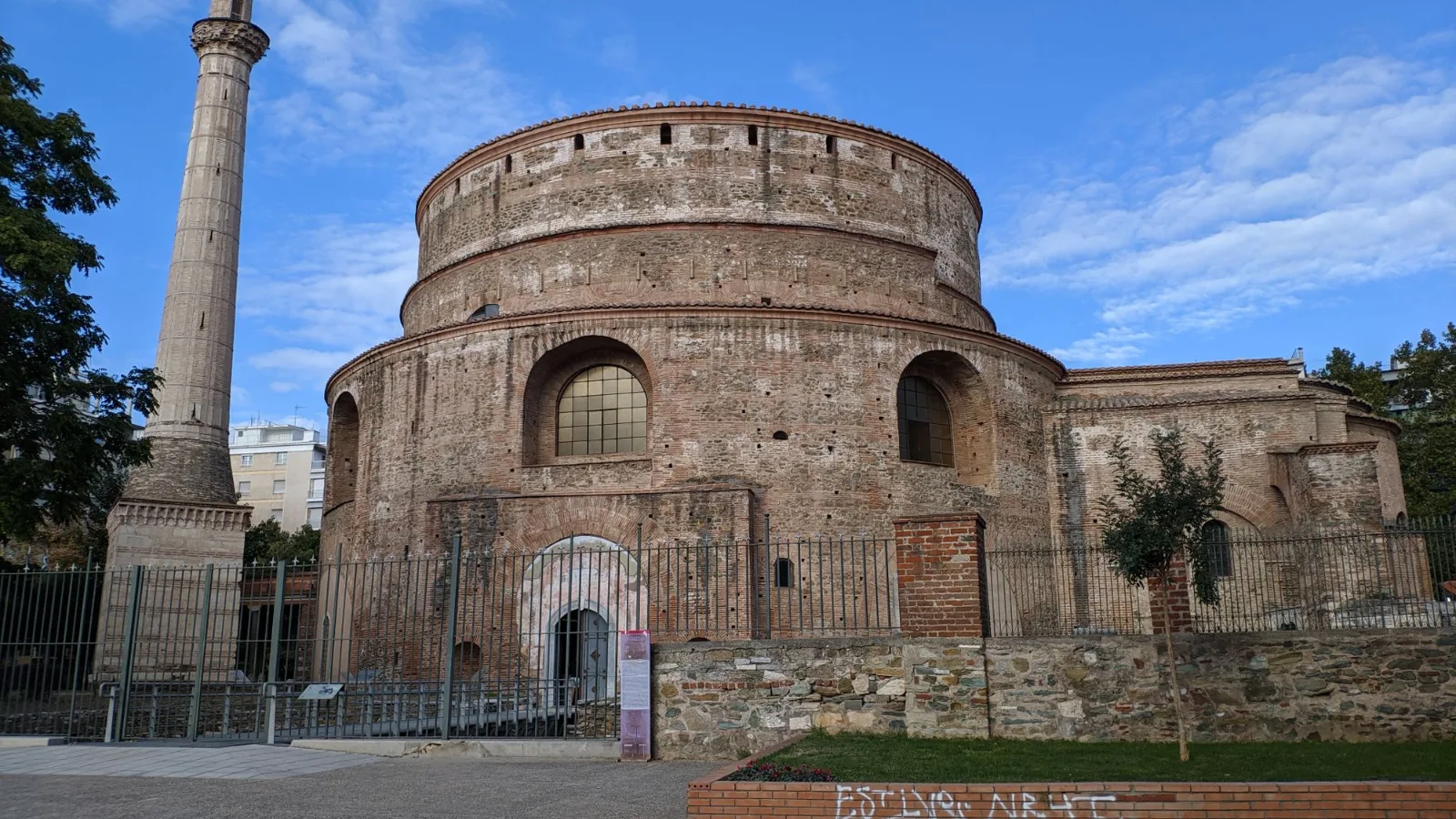
Around AD 300 the emperor Galerius made Thessaloniki his seat and built a vast palace complex in the heart of the city. The Rotunda, the arch and the palace all belonged to it. Today the three make a 90-minute walk, and the Rotunda is one of the city’s Paleochristian and Byzantine monuments on the UNESCO World Heritage list.
Rotunda and Arch of Galerius at a glance
Distances are straight-line from COLORS Urban Hotel Thessaloniki (OpenStreetMap). Hours shown are winter hours (1 November – 31 March).
| Monument | Winter hours | Ticket | Distance |
|---|---|---|---|
| Rotunda | 08:30–15:30, closed Tue | €10 (reduced €5) | about 1.2 km |
| Arch of Galerius (Kamara) | open-air, always visible | free | about 1.1 km |
| Galerian Palace complex | 08:30–15:30, closed Tue | €5 (reduced €3) | Navarinou Square |
What is the Rotunda?
The Rotunda is a circular building with walls 6.30 metres thick, 28 metres high and 24 metres across. It was built in Galerius’ time, but no one has been able to prove its original use: it may have been a temple, or the emperor’s own mausoleum. In the 4th century AD it became a Christian church, later a mosque, and today it is a monument. The minaret beside it dates from the Ottoman period.
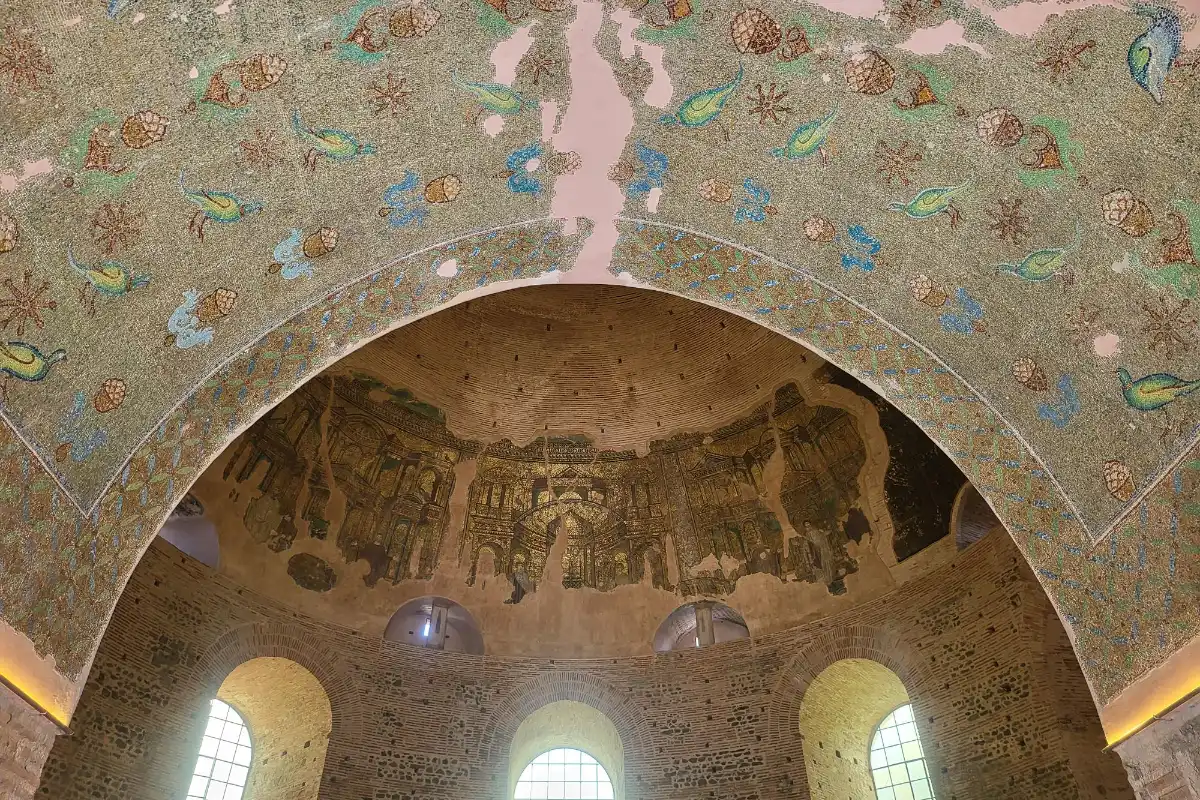
The reason to go inside is the early Byzantine mosaics in the dome and arches. In a broad band, martyrs stand with their arms raised in prayer in front of golden architectural façades. At the very top of the dome you can still make out a charcoal sketch, most likely of Christ within a medallion.
What does the Arch of Galerius show?
The arch is what remains of the triumphal gateway Galerius raised to celebrate his victories over the Persians. The surviving piers are wrapped in bands of marble reliefs showing battles, the emperor on horseback, prisoners and sacrificial ceremonies.
- Where to look: the piers facing Egnatia Street, where the reliefs are best preserved.
- When: early morning or late afternoon, when the low light brings out the detail.
- Meeting point: for locals, “Kamara” is the classic place to meet in the centre.
Is the Galerian Palace worth a visit?
Yes, if you like archaeology in the middle of a city. At Navarinou Square, a few minutes south of the arch, you see the palace foundations, the Octagon and mosaic floors. The complex covered more than 150,000 square metres and also included the Hippodrome. Its restoration has won awards from the European Union and Europa Nostra, and tickets are only €5.
How to combine the three monuments
- Rotunda: start here, at Agiou Georgiou Square, early in the morning.
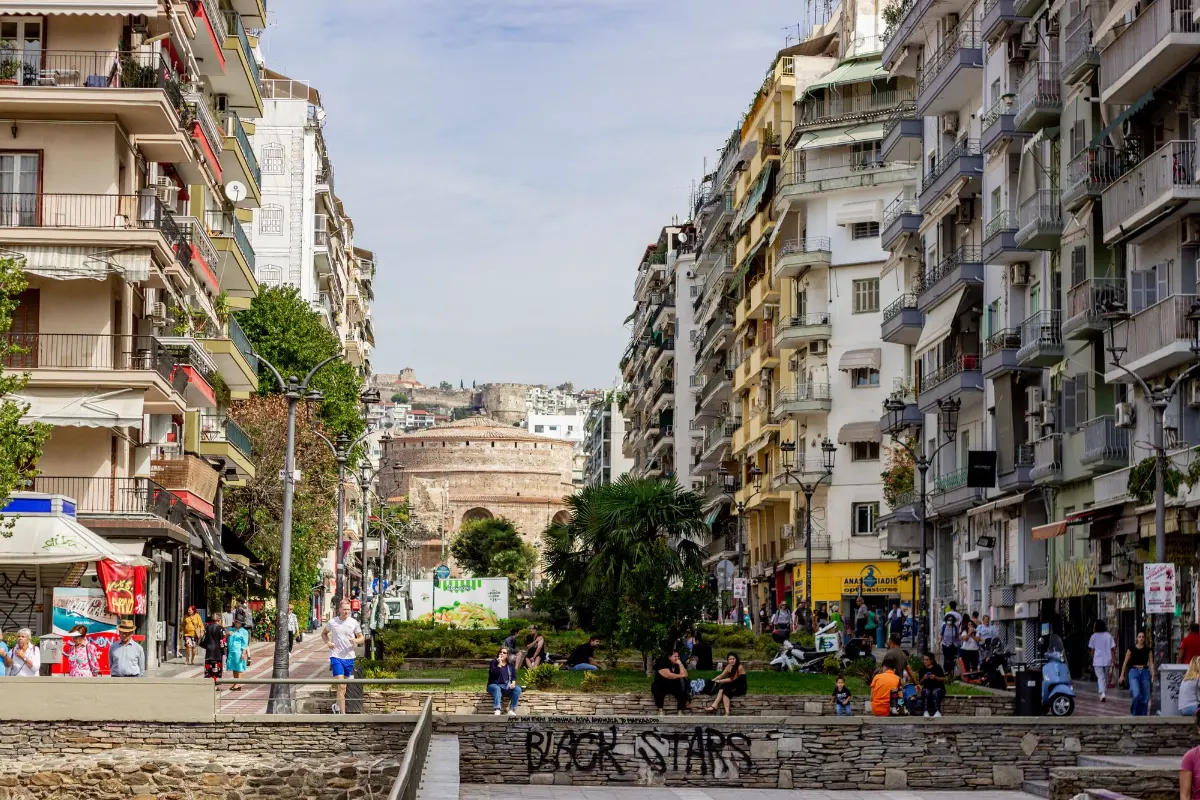
- Arch of Galerius: walk down the pedestrian street from the Rotunda to Egnatia, about 150 metres.
- Galerian Palace: continue south along Dimitriou Gounari Street to Navarinou Square.
- White Tower and waterfront: a few more minutes to the sea for a coffee with a view.
The route fits comfortably into a morning. To link it with the rest of the city, see our list of things to do in Thessaloniki and our 2 days in Thessaloniki itinerary.
What else is around the arch?
The streets around the arch are among the liveliest in the city, with student cafés, small restaurants and bookshops thanks to the nearby Aristotle University. It is worth lingering.
- Hagia Sophia: the Byzantine church with its striking dome is about 400 metres west, on the square of the same name, and is also part of the UNESCO listing.
- Navarinou Square: lined with cafés and tavernas, with the palace ruins in the middle. A good lunch stop.
- Museum of Byzantine Culture and Archaeological Museum: about 15 minutes on foot to the south-east, if you want to see finds from the same era.
How do you get to the Rotunda and the arch?
From COLORS Urban Hotel, a boutique hotel on Tsimiski Street, the arch is about 1.1 kilometres in a straight line, a pleasant 15–20 minute walk along Egnatia. If you prefer the metro, get off at Sintrivani on Line 1. Our Thessaloniki metro guide explains tickets and stations, and the hotel’s location and getting-here page has every route.
Read next
- Ano Poli and the Heptapyrgion: A Walk Through Old Thessaloniki
- Business Trip to Thessaloniki: A Practical Guide for Work Travellers
Frequently asked questions
How much is the Rotunda ticket?
A full ticket costs €10 and a reduced one €5. Entry is free on the first and third Sunday of each month from November to March, and on certain national days.
What are the Rotunda’s opening hours?
From 1 November to 31 March it is open 08:30–15:30 and closed on Tuesdays. In summer it stays open into the evening, with last entry 20 minutes before closing.
Do you need a ticket for the Arch of Galerius?
No. The arch stands on Egnatia Street in a public space, and you can see it for free at any time.
What is the difference between the Rotunda and the arch?
The Rotunda is a circular building with mosaics that served as a church and a mosque. The arch is a triumphal gateway with reliefs. Both belonged to Galerius’ palace complex.
How much time do I need?
About 30–45 minutes for the Rotunda, 15 minutes for the arch and half an hour for the palace. In total, a relaxed morning.
Which metro station is closest to the Rotunda?
Sintrivani station on Line 1, a few minutes on foot from the arch and the Rotunda.
Sources: Hellenic Heritage – ODAP / Greek Ministry of Culture (Rotunda and Galerian Palace complex: hours, tickets, history), UNESCO, OpenStreetMap for distances. Last checked: 20 October 2026.